


What "AIO" Stands For and Why It Matters for Your Marketing
If you have spent any time in marketing circles lately, you have probably seen the term "AIO" popping up next to SEO and content strategy. But what does AIO actually mean? Is it just another buzzword, or something you genuinely need to understand?
Here is the quick answer: AIO stands for Artificial Intelligence Optimization (sometimes called AI Optimization or GEO/Generative AI Engine Optimization). In a marketing context, it specifically means setting up your content and online presence so AI systems can find it, understand it, and recommend it to users.
Let's break down what that really means, why it is becoming essential, and how it fits alongside the marketing strategies you already know.
What Does AIO Mean, Exactly?
At its core, AIO is the use of artificial intelligence, machine learning, and data analysis to help a business make better decisions, run operations, and connect with its audience.
In digital marketing specifically, AIO means using AI to analyze user behavior and search intent, then shaping content and personalizing the customer experience so the right people find you and take action.
Depending on who you ask, AIO can refer to a few related but distinct ideas:
- Optimizing your content for AI engines. This is the definition most marketers care about right now: making sure your website and content are structured, clear, and reliable enough that major AI language models (LLMs) like ChatGPT, Gemini, and Claude will show, cite, or recommend you when someone asks a related question.
- Using AI to optimize your marketing operations. This covers areas like AI-driven ad targeting, predictive analytics, automated A/B testing, and personalized customer journeys.
- AI models optimizing themselves. A more technical use of the term, referring to how tech companies fine-tune their own AI models for better performance in regards to their specific applications.
For most businesses reading this, the first definition is the one that matters most day to day: getting found and chosen by AI systems, not just by traditional search engines.
AIO vs. SEO: What's the Difference?
Search Engine Optimization (SEO) was built for a web where people typed a search into Google and scrolled through a list of blue links in the SERPs (search engine results pages).
AIO is built for a web where AI systems read across many sources, combine the information into an answer, and give it directly to the user, often without a single click to any website, which by the way, decreases click-through-rates for website owners.
Here is an example of a Google AI Overview:
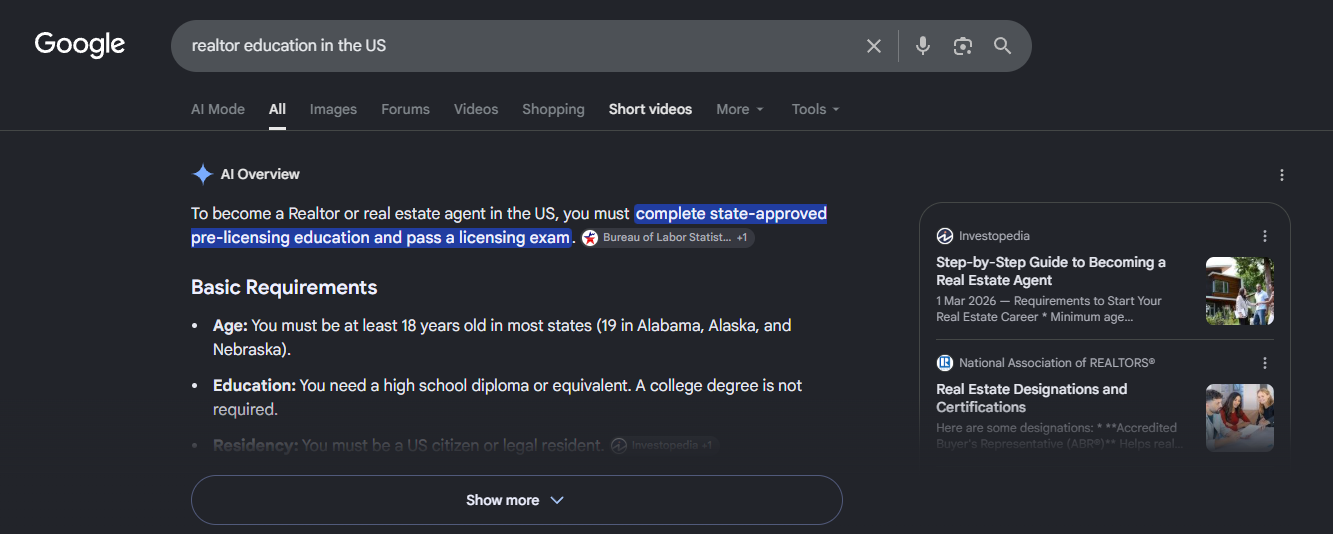
That shift is not just a theory. It is already changing how web traffic moves online.
More and more people are relying on LLMs to gather the information they need, even though the information is not always accurate.
A study from Ahrefs found that when an AI Overview appears on a Google search results page, the top-ranking organic result sees its click-through rate drop by around 58%.
Research from Seer Interactive tracked over 5 million search queries and found the organic click-through rate on AI Overview queries fell from roughly 1.76% to 0.61%, a 61% drop.
Pew Research Center found that when users see an AI Overview, only about 8% click through to a standard search result, compared to 15% when no AI Overview appears, a drop of roughly 47%.
SparkToro's research shows zero-click searches, meaning a search that ends without any click at all (all information needed is found directly in the AI Overview), reached 68% of U.S. queries in early 2026, up from about 60% two years earlier.
The takeaway is not that SEO is dead. It is that SEO alone is no longer enough.
AIO is the strategy that sits alongside it, focused on getting mentioned, cited, or recommended inside an AI answer rather than just ranking on a results page.
The Building Blocks of AIO
AIO relies on a few core technologies working together:
- Natural Language Processing (NLP). This is what allows AI systems to understand and create human language. It powers everything from chatbots to the way AI models interpret the meaning and context behind your content, not just the keywords on the page.
- Machine Learning (ML). ML lets systems learn from data patterns over time. In an AIO context, that means predicting customer behavior, personalizing experiences, and improving what content or products get shown to a given user.
- Predictive Analytics. This uses past and real-time data to forecast trends, customer paths, and likely outcomes, helping marketers get ahead of shifts in demand or interest rather than reacting after the fact.
Why AIO Is Becoming Impossible to Ignore
A few trends are coming together to make AIO a priority rather than a nice option.
AI-powered search is expanding fast. AI Overviews now appear on a large and growing share of Google searches, and that share varies significantly by industry, appearing on most healthcare and education queries in particular.
Being cited pays off. Even in an environment where overall clicks are down, being cited inside an AI Overview clearly beats being left out. Pages cited inside an AI Overview get a noticeably higher click-through rate than uncited pages on the same results page, though both still lag behind what a regular, non-AI search result used to get.
User habits are already shifting. A significant share of younger users are turning to platforms like TikTok and Instagram for search instead of Google, showing that discovery itself is moving away from traditional search boxes.
AI personalization already drives major business results. Netflix's recommendation engine, a well-known example of AI optimization in action, is estimated to influence more than 80% of the content watched on the platform. That is the kind of impact AIO aims to bring to marketing and content strategy as a whole.
How to Start Applying AIO to Your Business
You do not need to change your entire marketing setup overnight. A practical starting point looks like this:
- Audit your content for clarity and structure; if you need help with this, feel free to contact us. AI systems favor content that clearly answers a specific question, uses descriptive headings, and is easy to read. Vague, keyword-stuffed pages tend to get ignored.
- Build topical authority. Depth on a subject matters more than simple volume of pages. AI systems are more likely to cite sources that show real expertise on a topic.
- Bring your data together. Gather insights from your website analytics, social channels, email campaigns, and paid ads so you have a full picture of user behavior and search intent to work from.
- Add AI tools gradually. Use AI-powered analytics to spot patterns and opportunities, then apply those insights to personalize content and improve targeting.
- Track the right metrics. Traditional click-through rate is still useful, but also watch for brand mentions and citations inside AI-generated answers, since that is increasingly where visibility is won or lost.
- Keep learning. AIO is a young and fast-moving field. What works today will keep changing as AI search tools mature, so ongoing testing matters.
The Bottom Line
AIO stands for Artificial Intelligence Optimization: using AI to understand your audience and shape your content so both people and AI systems can find, trust, and use it.
As AI Overviews, chatbots, and other AI tools take over a larger share of how people search for information, treating AIO as an addition to your existing SEO and content strategy, rather than a replacement for it, is the smartest way to stay visible.
If you are not sure where your content currently stands with AI search tools, that is exactly the kind of gap I help businesses close. Reach out and let's talk about what AIO could look like for your brand.